


Your cart
0
Your cart is empty
But that's easy to fix! Choose something tasty and healthy from our catalog.


Erythritol, stevia, sucralose, allulose: sweetness, calories, GI, baking and safety. Which sweetener fits your task, compared using EFSA and WHO data.
Erythritol, stevia, sucralose, allulose: sweetness, calories, GI, baking and safety. Which sweetener fits your task, compared using EFSA and WHO data.
Start with a simple question: what exactly does sugar need to do in your dish — sweeten, add bulk, thicken or brown? Drinks and most baked goods only need sweetness, and that’s where concentrated 1:5 and 1:10 blends work best. Jam also needs body, and caramel needs to melt. Every job has its own best helper. Let’s figure it out together, so sweetness is a joy again, not a compromise.
Erythritol, stevia, sucralose and monk fruit give zero calories and zero effect on blood glucose and insulin, and they are the ones we recommend to people who monitor their blood sugar. Only real sugars and allulose caramelize. Xylitol, maltitol, isomalt and sorbitol are not zero: they provide 2.4 kcal/g, and maltitol has a noticeable effect on glucose.
Swipe to compare →
| Sweetener | Sweetness (sugar = 1) | kcal/g | GI | II | Diabetes / IR | Heat | Caramelizes | Laxative effect | Global status |
|---|---|---|---|---|---|---|---|---|---|
| Sugar (reference) | 1 | 4 | 65 | 43 | no | yes | yes | — | food |
| Erythritol | 0.6–0.8 | 0 | 0 | 2 | yes | stable, pale crust | no | above ≈35 g a day | authorized: EU (E968), US, Ukraine |
| Stevia | 200–400 | ≈0 | ≈0* | ≈0* | yes | stable, adds sweetness only | no | — | authorized: EU (E960), US, Ukraine |
| Sucralose | ≈600 | ≈0 | ≈0* | ≈0* | yes | heat-stable (FDA) | no | — | authorized: EU (E955), US, Ukraine |
| Allulose | ≈0.7 | 0.2–0.4** | ≈0*** | ≈0*** | yes | yes, browns | yes | from 0.4 g/kg at once | authorized: US, Australia, New Zealand; EU: not yet |
| Monk fruit | 100–250 | ≈0 | ≈0* | ≈0* | yes | stable | no | — | authorized: US; EU: under review |
| Xylitol | 1 | 2.4 | 13 | 11 | limited | stable | no | 35–50 g at once | authorized: EU (E967), US, Ukraine |
| Maltitol | 0.9 | 2.4 | 35 | 27 | no | stable | no | ≈30 g at once | authorized: EU (E965), US, Ukraine |
| Isomalt | 0.45–0.65 | 2.4 | 9 | 6 | limited | more stable than sugar | no, sets like glass | large portions | authorized: EU (E953), US, Ukraine |
| Sorbitol | 0.5–0.7 | 2.4 | 9 | 11 | limited | retains moisture | no | ≈20 g a day | authorized: EU (E420), US, Ukraine |
| Inulin | ≈0.1 | 2 | — | — | yes | — | no | gas if started abruptly | dietary fiber |
| Fructose | sweeter than sugar | 4 | 15 | — | no | yes | yes | — | sugar |
| Honey | — | 4 | 61 | — | no | yes | yes | — | sugar |
GI is the glycemic index (glucose = 100); II is the insulin index. *Non-nutritive sweeteners contain practically no carbohydrates, so they don’t raise glucose or insulin. **No EU or Ukrainian energy factor exists for allulose: 0.2 is the FSANZ estimate, 0.4 is the FDA figure. ***Allulose is a carbohydrate (a “rare sugar”), but the body gets almost no energy from it: in a study, 7.5 g of allulose taken on its own did not change glucose or insulin levels. No officially measured GI or II values exist for it yet. “—” means not applicable or no reliable data.
The ratios 1:5 and 1:10 show sweetening power, not ingredients: 1 g of the product sweetens like 5 g or 10 g of sugar. In practice, one teaspoon of sugar equals ≈1 g of SOLOSVIT Yellow 1:5 or ≈0.5 g of SOLOSVIT Orange 1:10.
| Sugar in the recipe | Erythritol (×1.4) | 1:5 blend | 1:10 blend |
|---|---|---|---|
| 1 tsp (≈5 g) | ≈7 g | ≈1 g | ≈0.5 g |
| 50 g | ≈70 g | 10 g | 5 g |
| 200 g | ≈285 g | 40 g | 20 g |
Erythritol is ≈30% less sweet than sugar, so you use more of it; with the blends you use 5 or 10 times less.
An example from our client’s question. She asked how to make a sugar-free egg-white glaze for Easter bread. Where sugar holds the structure, as in glazes, meringues and marshmallows, replace 1 cup of sugar with 1 cup of erythritol and 2 measuring scoops of SOLOSVIT Orange. Erythritol gives structure, volume and body, while Orange adds full sweetness without erythritol’s cooling aftertaste. It tastes just like sugar. One tip: a concentrated blend gives sweetness, not bulk, so in these recipes erythritol always holds the structure.
A blend removes the drawbacks of each ingredient. Erythritol gives bulk and a sugar-like texture, but it is 20–40% less sweet than sugar and cools the tongue. Stevia and sucralose are hundreds of times sweeter than sugar, so pure extract for a cup of tea is a few grains you can’t measure. On top of that, stevia tastes bitter at high concentrations: its glycosides activate the bitter taste receptors TAS2R4 and TAS2R14. But in a well-balanced blend, all that’s left is the taste of sweetness, just like sugar.
Why pure erythritol isn’t the answer for replacing sugar completely. To replace sugar completely, you need a lot of erythritol. Yet about 50 g a day is already above the acceptable daily intake that EFSA set for erythritol precisely because of its laxative effect (35 g for a person weighing 70 kg). Eaten in one go, that amount gives some people rumbling, bloating or loose stools. And in sweetness it’s only ≈35 g of sugar, about 7 teaspoons. That’s not enough for a cake, pancakes or tea sweetened the way you like: too little sweetness, a real risk of discomfort, and people go back to sugar. In a blend, erythritol becomes a convenient carrier for high-intensity extracts: 1 g of SOLOSVIT Yellow sweetens like 5 g of sugar, so you never get near those doses. That’s also why a jar lasts so long: a 200 g jar of Orange matches the sweetness of ≈2 kg of sugar.
Why one blend tastes bitter and another doesn’t. Almost everyone who has tried sweeteners has a “stevia tastes bitter” story. Bitterness depends on the dose, on the type of glycoside (stevioside is more bitter than rebaudioside A or M) and on how the extract is purified, and every extract manufacturer has its own technology. Labels usually don’t list the glycoside type, so choosing the “right” stevia by its package is almost impossible, and many erythritol-and-stevia blends on store shelves taste bitter.
That’s why, for SOLOSVIT sweeteners, we use stevia extract with an additional purification step, and it has no bitterness, so even stevioside, which is more bitter on its own, has no bitterness after this purification. In SOLOSVIT Yellow and Orange, sucralose adds fullness to the sweet taste, since its taste profile is the closest to sugar. And the measuring scoop in the jar helps you get the sweetness right. Our clients put it simply: finding a sugar substitute with no aftertaste that works for both baking and jam is “quite a quest.”
Below is a short guide to each sweetener: what it is, where it performs well, where it falls short and what its regulatory status is around the world. Read the profiles side by side to see why no single sweetener does every job. Click a name to expand it.
Erythritol is a sugar alcohol (polyol) that the body almost fully absorbs and excretes unchanged, so it provides 0 kcal and raises neither glucose nor insulin. Erythritol adds bulk, has sugar-like crystals and is heat-stable. Limits: it does not caramelize, can recrystallize in creams as they cool and has a laxative effect in large doses. Pure erythritol: SOLOSVIT, 500 g; read more in “Erythritol without myths”.
Stevia is a purified extract of Stevia rebaudiana leaves, 200–400 times sweeter than sugar. It has zero calories and does not raise blood glucose. Limits: it tastes bitter when overdosed and adds no bulk, so it works best paired with erythritol, as in SOLOSVIT Stevia (green jar) and SOLOSVIT Stevia+ (blue jar). Only purified extracts with at least 95% steviol glycosides are authorized.
Sucralose is made from ordinary sugar (sucrose) by replacing three hydroxyl groups with chlorine atoms. This keeps the taste of sugar but not its calories: the body gets no energy from it. Sucralose is ≈600 times sweeter than sugar and tastes closest to it. It is authorized in the EU, the US and Ukraine; in 2026, EFSA re-evaluated it and found no genotoxic risk. Sucralose is heat-stable according to the FDA (US), so it is used in both hot drinks and baking; the EU has not yet issued an opinion specifically on baking.
Allulose is a “rare sugar” found in small amounts in wheat, raisins and dried figs. It is ≈70% as sweet as sugar and has almost no calories, and, most importantly, allulose caramelizes and browns like real sugar. Allulose is authorized in the US, Australia and New Zealand. The EU has not authorized it yet: in 2025, EFSA could not complete its assessment because the applicant did not provide the required data, and no harm was identified. A single dose above 0.4 g per kg of body weight can have a laxative effect. SOLOSVIT Allulose is for caramel, a golden crust and thicker jam.
Monk fruit sweetener is an extract of Siraitia grosvenorii fruit, 100–250 times sweeter than sugar, with no calories. It is authorized in the US; in the EU, the extract is under review as a sweetener. Its taste often has a bitter note that takes some getting used to.
Maltitol, xylitol, sorbitol and isomalt are polyols with 2.4 kcal/g: less than sugar, but not zero. Maltitol (also listed as maltitol syrup, E965) is the trickiest: it tastes closest to sugar but has a GI of 35 and an insulin index of 27, which means it raises both glucose and insulin. Xylitol is as sweet as sugar and has a strong cooling effect; it is dangerous for dogs even in small amounts. Sorbitol retains moisture and can have a laxative effect from ≈20 g a day. Isomalt is only mildly sweet but sets into clear “glass,” which is why it is used for hard candy and decorations: SOLOSVIT Isomalt.
Inulin is a dietary fiber (a prebiotic), not a sweetener: it is ≈10% as sweet as sugar. Jerusalem artichoke syrup is made by breaking down inulin, so it contains fructose: it is a sweet product with calories, not a zero-calorie one.
Fructose, honey and agave syrup are often sold as a “healthy swap,” but for the body they are sugar: 4 kcal/g each, and honey has a GI of 61, almost as high as sugar (65). The WHO counts honey and syrups as free sugars and advises limiting them. Honey is about 80% sugars, so the trace of beneficial compounds in it doesn’t outweigh their effect on the body.
“Sugar-free” on the package doesn’t mean “no effect on blood sugar.” Manufacturers often replace sugar with ingredients that add calories and raise glucose but sound safer. When you read the ingredient list, look for two kinds of names: sugar under another name and “non-zero” substitutes. If your goal is blood sugar control or weight loss, they work against you.
Our rule is simple: choose sweeteners with zero calories and a zero glycemic and insulin index. SOLOSVIT jars, erythritol, liquid sweetener and powdered sweetener contain no maltitol, sorbitol, xylitol or fructose. See the full range in the SOLOSVIT sweetener catalog.
For diabetes, insulin resistance or quitting sugar completely, choose sweeteners with zero calories and a zero glycemic and insulin index: erythritol, stevia, sucralose and blends based on them, such as SOLOSVIT Yellow, Orange and erythritol. They don’t raise blood sugar, so there are no glucose-related limits. Maltitol, honey, fructose, agave and sugar syrups are not suitable: they add calories, and maltitol and honey also raise glucose.
Why: we look at the metabolic response. The body has no “scanner at the door” that reads a product’s name. It responds to what actually happens after a meal: whether glucose spiked, whether insulin was released, whether we got energy from protein, fat and carbohydrates. Erythritol leaves the body unchanged, sucralose is barely absorbed, and stevia provides no digestible carbohydrates, so glucose does not rise. Maltitol, honey and agave syrup, on the other hand, are broken down as carbohydrates: calories appear, and glucose and insulin go up. That’s why swapping sugar for “healthy” honey or “diabetic” sweets made with maltitol makes no sense.
Plan your diet for diabetes together with your doctor.
For most baking, use SOLOSVIT Orange or Yellow: a blend of erythritol, stevia and sucralose that sweetens like sugar and stays stable when heated. For jam, use the same Orange and pectin (sold in stores as a jam-making aid) or allulose for body. For caramel and decorations, use isomalt; for a golden crust, allulose. In baking, sugar does more than add taste, so choose your helper by its function.
Regulators in the EU and the US consider authorized sweeteners safe within the acceptable daily intake. The widely reported studies of 2023–2024 found associations and laboratory effects, but they did not prove that sweeteners cause harm, and newer 2026 evidence (EFSA’s re-evaluation of sucralose and a randomized erythritol study, still a preprint) did not confirm some of the concerns. Let’s look at the three topics we’re asked about most often.
In 2023, a study in Nature Medicine found that cardiology patients with the highest blood levels of erythritol had cardiovascular events more often. But the study measured erythritol in the blood, not how much of it people ate, and the body makes erythritol from glucose itself, with levels rising in diabetes and obesity.
In 2024, the same group showed that a single 30 g dose of erythritol temporarily increased platelet clumping in 10 healthy volunteers; the study was small and did not measure heart events. And in September 2026, researchers from Basel and Bern (Switzerland) published a randomized crossover study in which 50 g of erythritol did not increase platelet clumping in 14 healthy people compared with water. It is a preprint that has not yet been peer-reviewed, and it does not prove long-term safety, but while the alarming headlines reached everyone, results like these get far less attention. EFSA and the FDA concluded that a causal link has not been shown.
The practical takeaway: stay within the acceptable daily intake, which is 35 g of erythritol a day for a person weighing 70 kg; people at high cardiovascular risk should discuss sweeteners with their doctor.
A 2023 test-tube study found genotoxicity in a sucralose impurity, sucralose-6-acetate. In 2026, EFSA reviewed these data and found no genotoxic risk for sucralose or its impurities.
The WHO conditionally recommends against using sweeteners for weight control: in its assessment, they do not help reduce body fat in the long term. This recommendation does not apply to people with diabetes or to polyols, including erythritol. The WHO’s main advice is to cut free sugars to 10% of calories, ideally to 5% (≈25 g, about 6 teaspoons a day). At SOLOSVIT, this is exactly where we see the role of zero-calorie sweeteners: removing free sugar without giving up sweet taste.
There is no limit related to blood sugar: non-nutritive sweeteners don’t raise glucose. The limit is the acceptable daily intake (ADI), which is set with a large safety margin, and for erythritol it reflects digestive comfort. For a person weighing 70 kg, that is 35 g of erythritol, 280 mg of stevia (as steviol equivalents) or 1,050 mg of sucralose a day. With 1:5 and 1:10 blends, you’ll practically never reach these limits.
For a 60 kg person: erythritol 30 g, stevia 240 mg, sucralose 900 mg. Our calculation, based on EFSA values.
With 1:5 blends, the limit is far away: 35 g of erythritol equals ≈35 cups of coffee sweetened with SOLOSVIT Yellow. With pure erythritol, the limit is closer: ≈7 g per cup, or ≈5 cups, and a slice of dessert made with pure erythritol can contain 20–30 g. That’s why we recommend concentrated blends for everyday use.
On a sweetener label, check three things: the sugar claim, the polyol warning and the full ingredient list. A “sugar-free” claim has a legal limit, polyols trigger a laxative warning, and only the ingredient list shows whether the product also contains caloric ingredients such as maltitol or syrups. EU rules are listed first; Ukraine applies equivalent rules.
Ukraine applies equivalent rules to these claims and to the polyol warning. In addition, MOH Order No. 45/2024 requires table-top sweeteners with polyols (including erythritol) to carry the laxative-effect warning whatever their polyol share.
The color of a SOLOSVIT jar tells you two things: how sweet it is and whether it contains sucralose. The yellow and orange jars are a blend of erythritol, stevia and sucralose, our pick for coffee, baking and jam. The green and blue jars are sucralose-free, for those who prefer stevia only. All of them have zero calories and a zero glycemic and insulin index.
| Jar | Ingredients | Sweetness | Best for |
|---|---|---|---|
| Yellow «СОЛОСВІТ» (SOLOSVIT) | erythritol + sucralose + stevioside | 1:5 | coffee, tea, baking, desserts |
| Orange «СОЛОСВІТ+» (SOLOSVIT+) | erythritol + sucralose + stevioside | 1:10 | baking, jam, drinks; the most economical |
| Green «СОЛОСВІТ Стевія» (SOLOSVIT Stevia) | erythritol + stevioside | 1:5 | drinks and baking without sucralose |
| Blue «СОЛОСВІТ Стевія+» (SOLOSVIT Stevia+) | erythritol + stevioside | 1:10 | drinks and baking without sucralose |
| Erythritol | 100% erythritol | ≈0.7 | meringue, glaze, sponge cake: wherever you need bulk |
| Allulose | 100% allulose | 0.8 (manufacturer’s data) | caramel, a golden crust, thicker jam |
| Isomalt | 100% isomalt | mild | hard candy and decorations |
| Liquid | water + erythritol + sucralose | — | drinks |
None of the sweeteners in this table contains maltitol, sorbitol, xylitol or fructose.
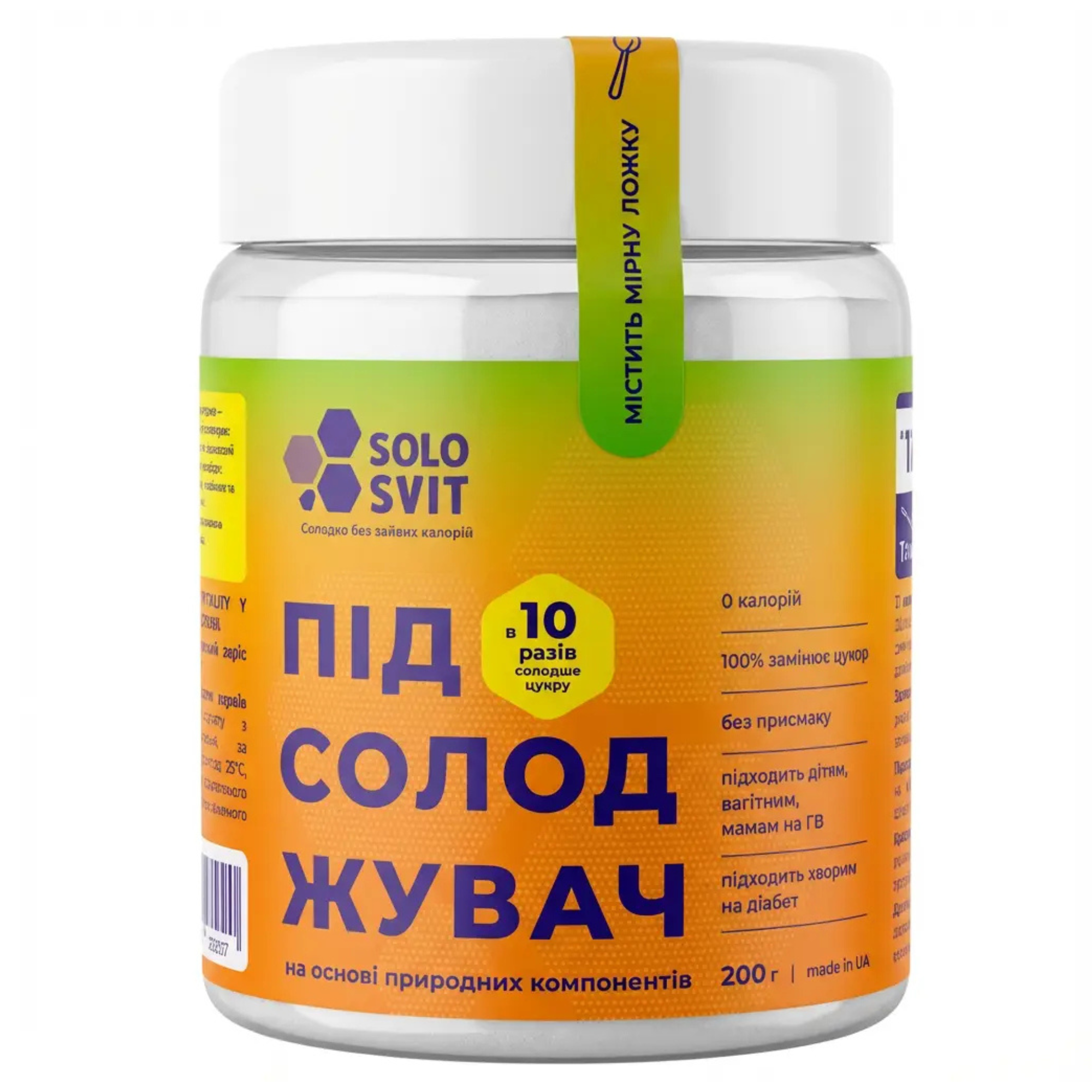 Orange jar 1:10For baking and jam
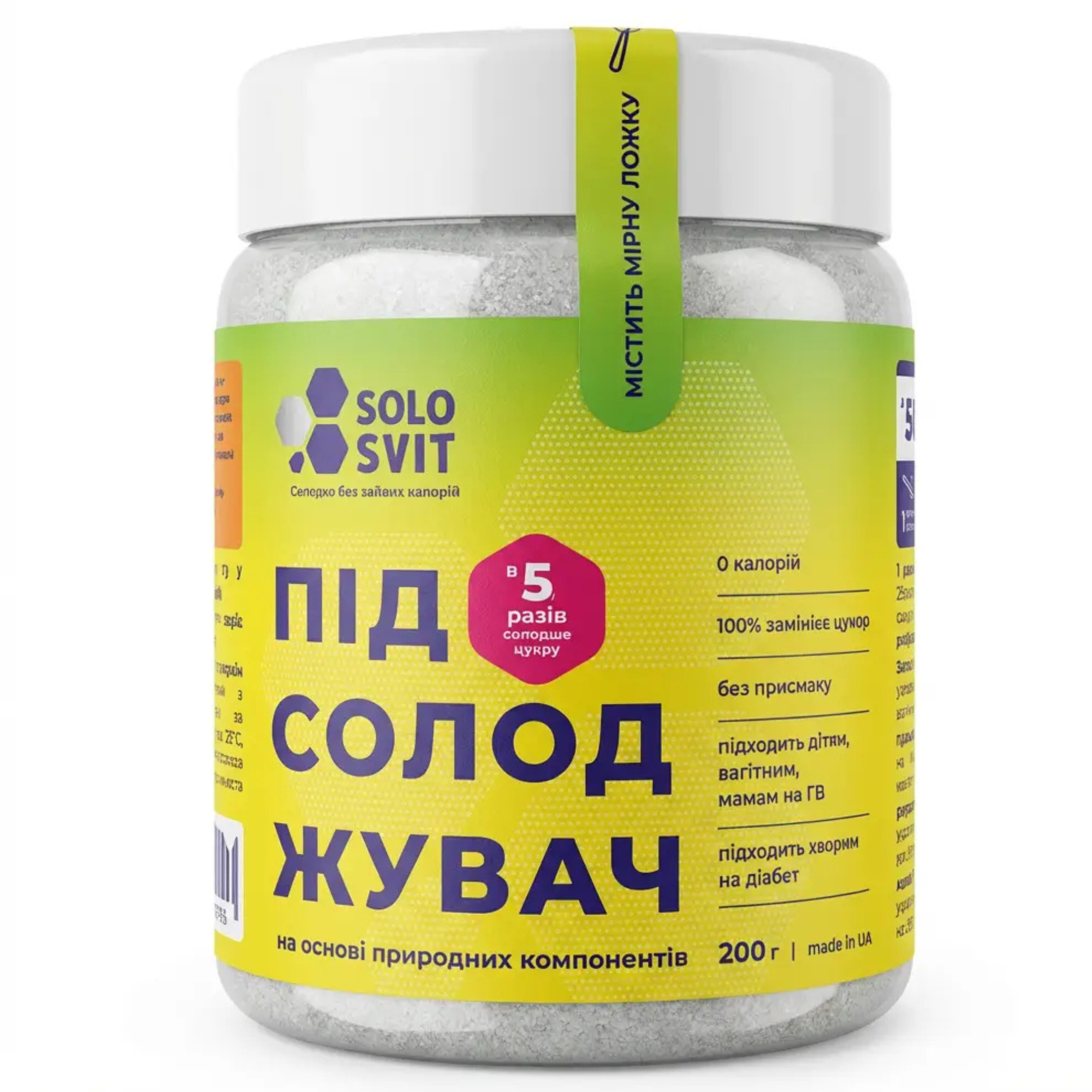 Yellow jar 1:5For coffee, tea and desserts
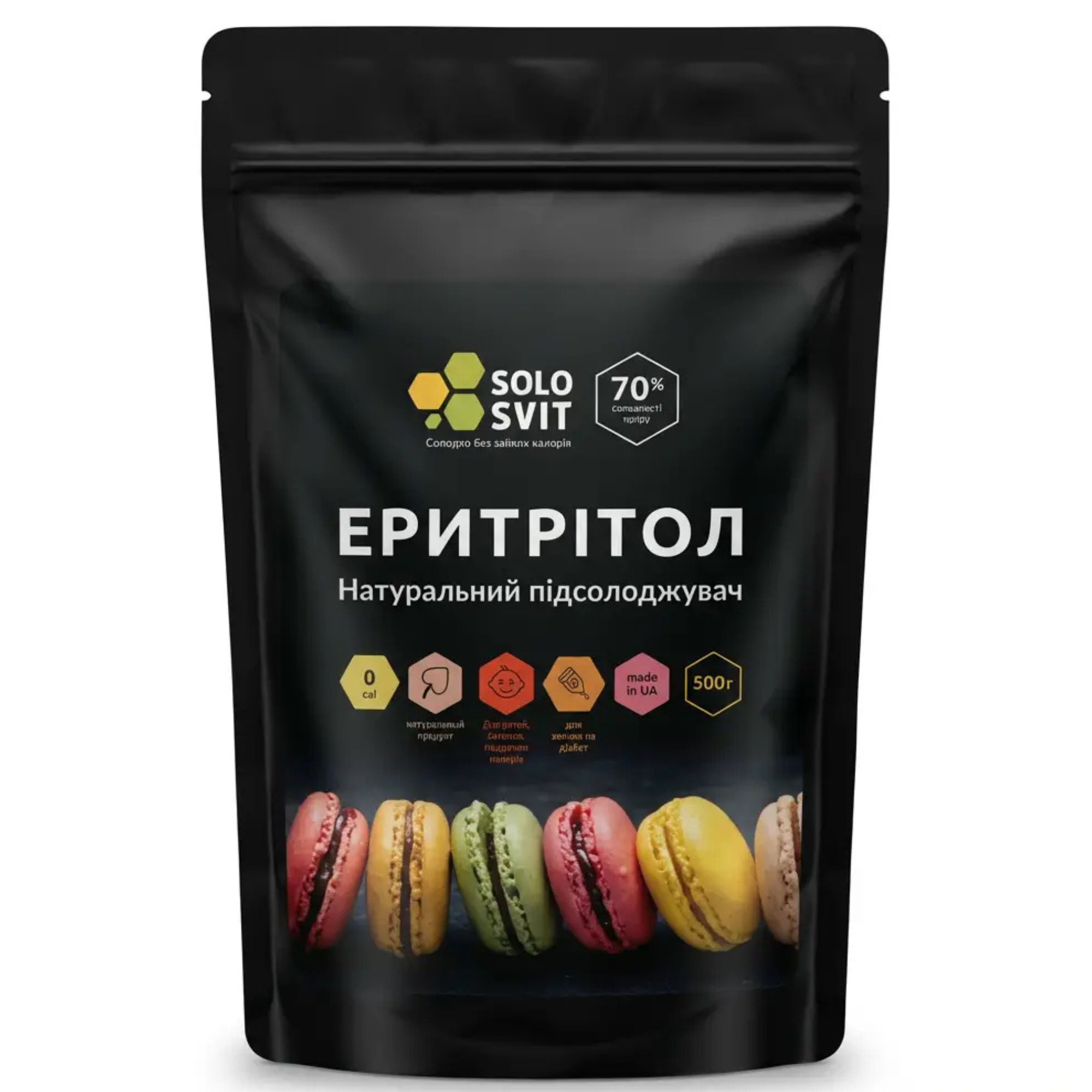 Erythritol 500 gBulk for meringue and glaze
We created SOLOSVIT because the best solution simply didn’t exist. What was on the shelves tasted bitter, left a cooling aftertaste or hid maltitol and fructose inside, and made you choose between taste and health. And concentrated sweeteners, whose safety is well studied, were inconvenient to use in everyday life.
For 10 years we have been studying how sweeteners affect people: on ourselves, on our families and through thousands of conversations with our clients. Our recipes aren’t “buy, mix, sell.” They are our own technology, additionally purified stevia extract and the expertise of founders who live and breathe this topic. We think not only about how it tastes today, but about how sweetness will affect you years from now.
We have a big goal: to see as few people as possible in Ukraine suffering from the effects of too much sugar, such as excess weight, type 2 diabetes and insulin resistance. Our part in this is to give you sweetness without sugar. Every SOLOSVIT jar — yellow, orange, green or blue — means zero calories, a practically zero glycemic and insulin index, and a sugar-like taste with no bitterness. No maltitol, no hidden sugar, no compromises.
We’re on your side, and we want you to be able to give up sugar without giving up sweetness. Try SOLOSVIT Orange in your favorite recipe, and maybe you’ll say it too: “Wow, you mean I could have done this all along?”
Blends of erythritol with stevia and sucralose, like SOLOSVIT Yellow and Orange, come closest: erythritol provides a sugar-like texture, and a small share of stevia and sucralose provides full sweetness without bitterness. Among single ingredients, maltitol is close to sugar in taste (but it raises glucose), and allulose is close in both taste and baking behavior.
Yes. The FDA (US) considers sucralose heat-stable, so it is used in hot drinks and baking.
At high concentrations, steviol glycosides activate the bitter receptors of the tongue, and some of them, such as stevioside, taste more bitter than purified rebaudioside A, especially in cheap, poorly purified extracts. Purification matters too: for SOLOSVIT sweeteners we use stevia with an additional purification step, so they don’t taste bitter. A smaller dose or a blend with erythritol also helps. Our advice: don’t “get used to the bitterness”; choose the best option for yourself, one that makes it easy and delicious!
Hidden sugars are ingredients that replace sugar on the ingredient list but still provide calories and often raise glucose: dextrose, fructose, glucose-fructose and maltose syrups, honey, agave syrup, and maltitol (maltitol syrup). If your goal is blood sugar control or weight loss, choose sweeteners with zero calories and a zero glycemic and insulin index.
A zero-calorie sugar substitute removes the calories of sugar from your diet without taking away sweetness. On its own, it doesn’t burn fat: the result depends on your whole diet, and it’s important not to “make up” for the saved calories with other food.
Choose only fully natural sweeteners with zero calories and a zero glycemic and insulin index. That way they won’t affect your body and will let you enjoy the sweet taste! These are SOLOSVIT sweeteners based on natural ingredients. But avoid the artificial tabletop sweeteners you find in every coffee shop, such as aspartame and sodium cyclamate: they have been recognized as potentially carcinogenic. Consult doctors who are familiar with current protocols for managing such patients. As a simple check, ask your doctor about using sweeteners in everyday life: if the answer is something like “better not to eat them at all,” look for a doctor who can explain which sweeteners to avoid and which are completely safe.
Most often the reason is the dose: 0.5 g of a 1:10 blend is hard to measure accurately with a spoon, and taste quickly adapts to sweetness. In cold drinks, sweetness really is perceived as weaker because of how taste receptors work. Erythritol, stevia and sucralose are chemically stable under normal storage and do not “wear off” when exposed to air. You can also alternate sweeteners of different strengths so you don’t get used to the intensity.
Erythritol absorbs heat as it dissolves, so crystals melting on the tongue feel cool, like mint. Once dissolved in a drink or used in a blend, erythritol has almost no cooling effect.


 1 min